Do you believe ‘wine glasses affect wine flavor’? It sounded like marketing speak. That changed until I attended a tasting led by a brand VP, where we went through how different glass shapes influence wine perception. For the first time, I started to think there might be science behind it.
Wine flavor perception sits at the intersection of hard science and something far more elusive, culture, language, memory, and personal experience. Not every sensation and phenomenon can be traced back to a single, clean scientific explanation. So, this piece focuses only on the physical and chemical interactions that are observable and reasonably quantifiable.
The short answer for the question of the title: a wine glass doesn’t change the wine itself. It changes how the wine presents itself to you, what is the aromatic compounds reach your nose, and where the liquid first contacts your mouth.
The Geometry of a Wine Glass

A few key parameters matter. The diameter of the rim determines how much aroma can escape; the headspace above the wine determines which aromatic compounds you smell; the overall shape governs how the wine interacts with air and how aromas develop; and the rim angle influences where the wine lands on your tongue first.
Let’s Start with Alcohol
Setting aside what happens in the mouth, two things worth attention are aroma and alcohol. Ethanol is volatile and irritating, from a pure enjoyment standpoint, the less of it you perceive, the better.
Researchers at Tokyo Medical and Dental University once built a custom “sniffer camera” to image ethanol vapor distribution above different glass types at varying temperatures.
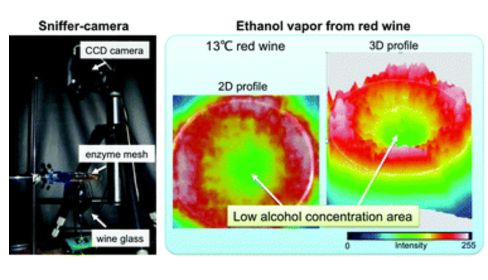
The main finding was at lower temperatures (13°C), a standard wine glass produced a ring of high ethanol concentration at the rim, while the concentration at the center of the opening was only about half as high. Other glass shapes like whisky glass and straight cup didn’t show the same pattern.
The experiment is observation base without any mechanism proposed. But the logic behind it is easy to piece together. The wider base gives ethanol more surface area to evaporate from. The narrowing neck then restricts how quickly it can escape, causing it to accumulate along the inner walls and concentrate at the rim edge.
Here’s the catch, the accumulated alcohol could make the wine more irritating, not less. A straight sided glass instead function better on ethanol disperses. In terms of minimizing alcohol perception, the traditional wine glass shape may not have the advantage as we assume. However, the amount of ethanol that able to escape from wine is limited. Ethanol and water form hydrogen bonds that constrain volatility. Unless the wine is poorly made, that harsh alcohol hit is quite rare.
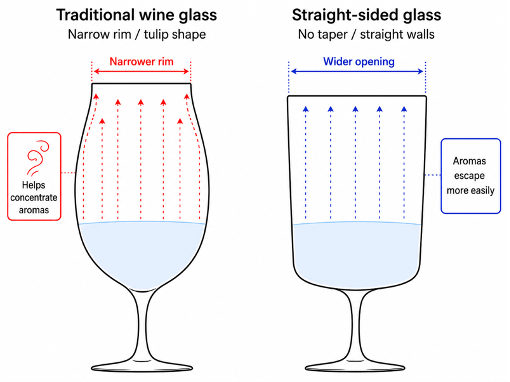
This experiment doesn’t prove that a wine glass enhances the tasting experience, while we can still apply the same logic to aroma compounds, and when we do, the conclusion flips entirely.
What Are You Actually Tasting?
Have you ever stopped to think about what you’re tasting when you “taste” wine?
You may think you’re tasting with your tongue, but your nose is the one running the show. Flavor isn’t generated in the mouth. It’s constructed by the brain from olfactory signals. Aroma molecules travel from the back of the mouth into the nasal cavity, and the brain combines those signals with visual cues, texture, and memory to build what you experience as “the taste of this wine.” This is why wine tastes like almost nothing when you have a cold and have a blocked nose.
A study tested the same Gewürztraminer across five vessel shapes: a white wine glass, a Bordeaux glass, a standard red wine glass, an INAO tasting glass, and an Erlenmeyer flask. Measuring both headspace chemical composition and sensory perception over time. The differences were barely perceptible at first, but as equilibration time increased, each glass began to develop a distinctly different aromatic profile. The Bordeaux and INAO glasses enhanced fruitiness and overall aroma intensity, while the standard red wine glass amplified the hot, ethanol character.
Four Glasses, One Tasting

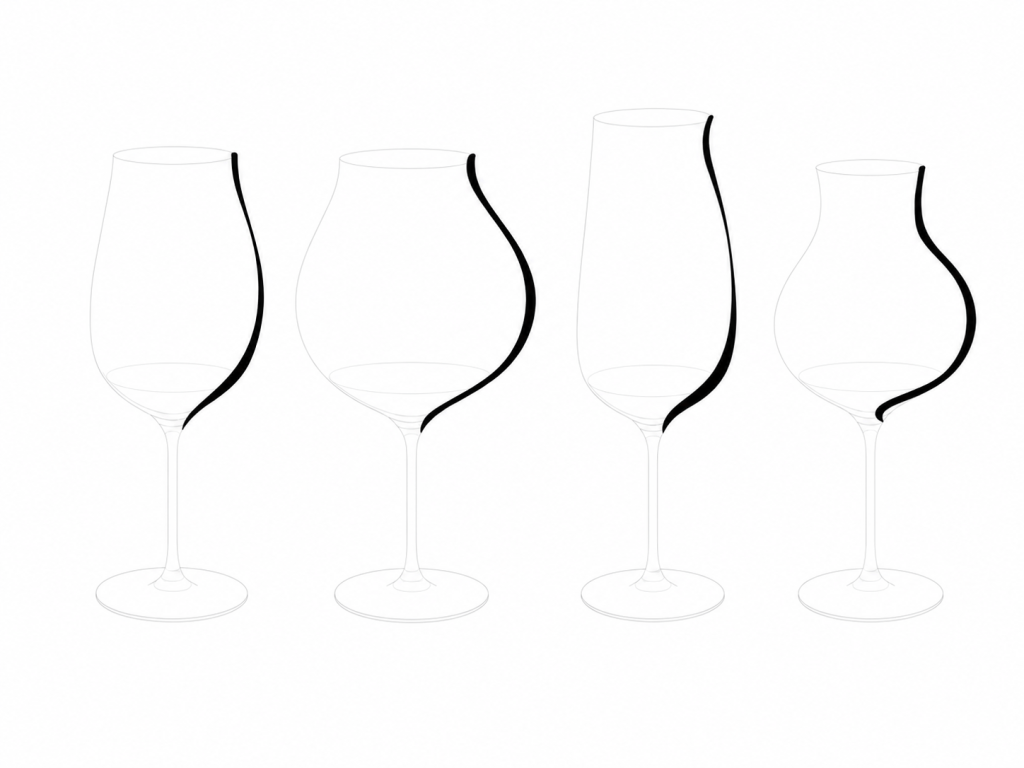
At the tasting I attended, we tested four glasses at different price points and with different intended functions, using several wines. The comparison that stuck with me most was between Glass 1 and Glass 2, both were designed for white wine and tested with the same oaked Chardonnay. Glass 2 was noticeably shorter and had a wider opening.
Oaked Chardonnay carries a dense aromatic load, dried fruit, butter, and cream layered over fresher fruit notes. In Glass 1, the narrow opening compressed all of that into a tight channel. Not unpleasant, but not very breathable either. Potentially overwhelming if you’re trying to pick apart individual notes from the crowd.
Glass 2, despite looking unconventionally squat at first glance, felt entirely different. The wider rim gave the aromas room to spread, and the fresh fruit notes became more pronounced, a better balance between the heavier and lighter elements.
One thing worth mentioning, during my tasting the wine in Glass 2 was poured directly from Glass 1. That extra transfer meant the wine got another moment of air exposure on the way over, which may have helped the aromas open before Glass 2 even had a chance to do its job. So how much of the difference was the glass, and how much was the pour? Hard to say.
Glass 3 has a distinctive shape, designed specifically for Pinot Noir. The rim flares slightly outward. To drink from it, you naturally tilt your head back a little or raise your glass higher, which causes the wine to land on your tip of the tongue first. For this specific phenomenon, the brand narrative is that the tongue tip is more sensitive to fruit and sweetness, which would make this design ideal for Pinot’s delicate fruit character.
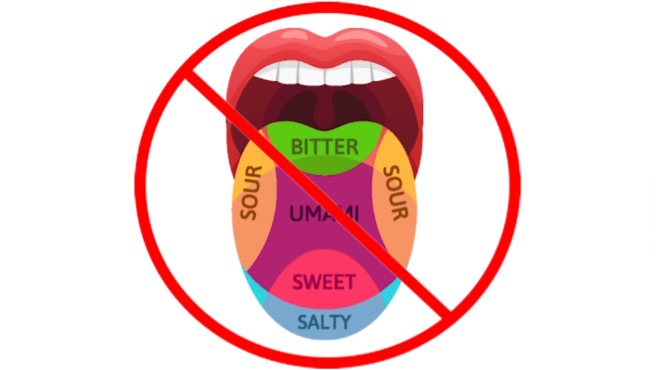
That claim doesn’t hold up well under neuroscience, the classic “tongue map,” which suggests different parts of the tongue are responsible for detecting different tastes, has been widely debunked as an oversimplification.
picture copy from: https://www.youtube.com/watch?v=0klEcayEJ_o
Taste receptor cells are distributed across the entire tongue, and regional differences in sensitivity are minimal. But whether it’s placebo or not, I genuinely found it easier to pick up Pinot’s silky chocolate quality when drinking from Glass 3.
Glass 4 has a wider, vertical rim, which allows the wine to spread across the full surface of the tongue and flow toward the sides. There’s an interesting piece of physiology here: the salivary glands open on the inner sides of the mouth, so when acidic wine reaches that area, it triggers saliva production more directly. That saliva does double duty; diluting acidity on one hand and providing protein for tannins to bind with on the other, which softens astringency.
So, Which Glass Should You Use?
To date, even though we can observe differences across glass shapes, no study has yet established a clean, quantitative relationship between specific glass geometry parameters and specific sensory outcomes. The phenomenon is real; the mechanism remains imprecisely defined.
The physical and chemical interactions we’ve covered really come down to two things: how aromas concentrate, and how the wine enters the mouth. Bowl width determines the surface area for air contact and aroma development. The taper of the rim determines how concentrated the headspace aromas are. Rim diameter and edge angle influence flow speed, contact area, and first landing point.
Once you understand those two factors, the logic for choosing a glass becomes fairly intuitive.
For unoaked whites like Chablis or Sauvignon Blanc, the aromas are delicate and volatile. They don’t need a large headspace to develop. A smaller opening helps prevent them from dissipating too quickly. A standard white wine glass will work just fine.
For oaked whites like Chardonnay, the situation reverses. The heavier aromatic compounds can crowd out the fresher notes in a narrow glass, creating a sense of congestion. A slightly wider opening gives the different volatile fractions room to separate and breathe.
Red wines generally have higher aromatic complexity potential. A wider bowl and rim increase the surface area available for aroma release and air interaction, and they also give you room to swirl. Which, in the short term, is the most effective way to open up a wine’s aromatics rather than just waiting.
Editor: Claude Code & ChatGPT
Pictures designed by me generated by ChatGPT
Reference:
- Arakawa, T., Iitani, K., Wang, X., Kajiro, T., Toma, K., Yano, K., & Mitsubayashi, K. (2015). A sniffer-camera for imaging of ethanol vaporization from wine: The effect of wine glass shape. Analyst, 140(8), 2881–2886. https://doi.org/10.1039/c4an02390k
- Hirson, G. D., Heymann, H., & Ebeler, S. E. (2012). Equilibration time and glass shape effects on chemical and sensory properties of wine. American Journal of Enology and Viticulture, 63(4), 515–521. https://doi.org/10.5344/ajev.2012.11113
- Lu, Y., & Bennick, A. (1998). Interaction of tannin with human salivary proline-rich proteins. Archives of Oral Biology, 43(9), 717–728. https://doi.org/10.1016/S0003-9969(98)00040-5
- Shepherd, G. M. (2012). Neurogastronomy: How the brain creates flavor and why it matters. Columbia University Press.


Leave a Reply